

Metal Structured Packings
Why Choose Us?
Rich Experience
PM has been established for more than 20 years, is a leading manufacturer specializing in tower packing we have been focusing on building an one-stop chemical packing E-commerce platform, aiming at satisfying customers comprehensive chemical packing demand and providing fast full service.
Global Sales Network
The products are exported to the North America, South America, Europe, Southeast Asia/ Mideast, Africa, East Asia (Japan/ South Korea). more than 120 countries.
Quality Service
We not only promote qualified product, also emphasize on providing professional technique and good service. Providing fast and convenient delivery of goods for customers is our constant pursuit. In order to meet customers need for products & services anytime and anywhere, we have established a strong service system.
Advanced Equipment
75 Meters full automatic production line, Packaging Machine, Sintering Furnace,Forming Machine,Vacuum Extraction Machine,Mixing and Stir Powder Tower, Carbon Dioxide Tester,Resistance Furnace, Drying Cabinet,Digital Display Comprehensive Testing Instrument for Strength of Engineering Ceramics, Particle Abrasion Tester, Moisture Tester, Particle Strength Tester, Digital Viscometer,Electrical Scale.
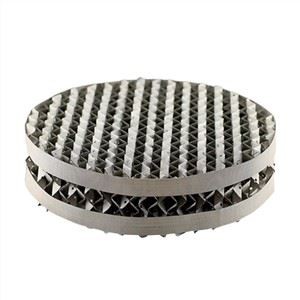
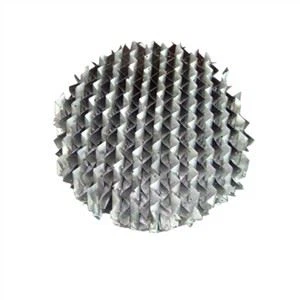
Metal structured packings are constructed from corrugated and textured metal sheets. The angle of inclination of the corrugations of adjacent sheets is reversed with respect to the vertical column axis, forming mixing cells at every point where the corrugations intersect. The result is a very open honeycomb structure with inclined flow channels giving a relatively high surface area but with very low resistance to gas flow. This structure ensures an excellent and uniform wetting under low and high liquid loads. Column operation at low liquid loads call for specially designed distributors to ensure adequate surface wetting.
Each subsequent layer of metal structured packing is rotated 90°so that the sheets of one layer are perpendicular to the sheets of the layer above and below. While passing through each layer, gas and liquid are thoroughly mixed in the direction parallel to the plane of the sheets. By rotating subsequent layers, excellent mixing and spreading, both side-to-side and front-to-back, of fluids are obtained over the entire cross-section of the tower.
Perforations and surface texturing maximize liquid spreading. These characteristics tend to show significant performance benefits in low pressure and low irrigation rate application.





Low-pressure Drop: Compared to other packing options, metal structured packing, especially gauze packing, offers very low-pressure drop and is a better choice for more volatile chemicals.
Large Surface Area: In the column packing, there needs to be a lot of opportunity for liquid and vapor contact. The best way to do this is to spread the liquid into a thin film, which metal structured packing does better than any other packing method.
High Efficiency: Metal structured packing has excellent separation and filtration efficiency compared to trays and . This means more filtration can be achieved with shorter columns.
High Capacity: The tightly organized internal structure of metal structured packing enables columns to be more efficient and pack more volume than other packing types. This increased capacity also increases operating costs and rates.
Maximize Liquid And Gas Flow: Metal structured packing is designed to handle larger flow rates than bulk packing, making it more suitable for high flow rates.
Surface Area Maximization
Metal structured packing is characterized by a high surface area, achieved through the arrangement of corrugated or textured sheets.
The increased surface area promotes greater contact between vapor and liquid phases, facilitating efficient mass transfer.
Uniformity And Consistency
Unlike random packing materials, metal structured packing is engineered for uniformity and consistency in design, ensuring predictable performance and reliability.
Materials And Construction
Metal structured packing can be constructed from various materials, including metal,depending on the specific requirements of the distillation process.
The choice of materials influences factors such as corrosion resistance and thermal conductivity.

Applications of Metal Structured Packing

Fractional Distillation
● Metal structured packing excels in fractional distillation processes, where it aids in the separation of components based on their boiling points.
● Its high efficiency is particularly beneficial in industries such as petrochemicals and pharmaceuticals.
Azeotropic Distillation
● In situations where azeotropes pose challenges, metal structured packing facilitates precise separations, offering improved control over the distillation process.
The Role of Metal Structured Packings
By associating a lower pressure drop and high efficiency, today's metal structured packings are the first choice for vacuum column design or revamps or at moderate pressures, for increased capacity or efficiency especially in situations free of severe fouling and polymerization risks. There are, however, limitations on their use in cases of high pressure, because of detachment of the wall fluid, backmixing and other effects. Nevertheless, there are cases where even at high pressures these packings can be considered.
Pressure Drop – Its value by theoretical stage is much smaller than other internals, increasing as the vapor or liquid flow is increased.
Capacity Limit – It is defined as the point at which column operation stops being controllable. As the packing approaches flooding, small increments in the ratio of liquid or vapor can lead to a sharp increase of pressure drop and liquid holdup, causing excessive retention in the column. Above this value, the transfer efficiency is also hindered.
The capacity limit of metal structured packings is highly dependent on its model and geometry, and is often far superior to that of other internals.
Liquid Holdup – Liquid retention in the column promoted by the presence of the packing. Its value increases with increasing liquid flow.
HETP – Height equivalent to a theoretical plate, or equilibrium stage in mass transfer. In metal structured packings, it is not very sensitive to load conditions in the column over normal operation, and it is practically the same for different operating pressures. However, it may be hindered by poor distribution of liquid.
History of Structured Packing
Structured packing has always been an option for scrubber columns for decades. Such a concept first made its inroads in the early 1940s and found its patented form in the 1950s. These initial iterations primarily employed wavy-form sheet metal, new iterations using wire mesh later developed in the 1950s and were widely used until the 1970s. This second generation of mesh bore testimony to restricted usage owing to high cost and low capacity.
The third generation of structured packing columns came into being in the late 1970s with corrugated structured patterns, providing higher capacity at lower cost with an overall better performance. This new structure was tweaked in the following decades, leading to changes in the shape and design of materials for improving the surface area, and wettability with other factors.
Currently, one can avail of numerous structured packing, primarily constituting thin metal sheets or wire gauze. Plastic and porcelain alternatives are also available in keeping with the processed liquid type.
Types of Structured Packing
Gauze is woven structured packing consisting of wire gauze material creating very small openings for maximizing surface area, preferred for low liquid rate applications and areas requiring the lowest possible pressure drop per theoretical stage-an apt and ideal choice for processing specialty chemicals, pharmaceuticals, temperature-sensitive material.
Knitted wire packing consists of multi-strand wires knitted into high-density mesh used as one-piece layers or stacked into near-solid bricks, offering large surface area and efficient mass transfer with high-pressure drop than gauze packing.
Sheet metal constitutes sheets of textured metal material arranged into bundles, significantly less expensive than wire materials. It's durable and capable of handling an extensive range of liquid and vapor rates and process services, with applications including vacuum, atmospheric distillation services, and wastewater treatment functionalities.
Grid packing comes in two types-corrugated sheet packing and stamped blades connected to panels, having high durability and fouling-resistant-best choice for extended operation in fouling services like fractionation and wastewater treatment.
Feature of Metal Structured Packings
● Metallic materials to suit different environments.
● Large contacting surface area and uniform liquid and gas distribution.
● Reduced liquid hold-up and high flux.
● Ideal for distillation, separation, purification and other processes.
● High temperature and chemical stability for high performance.
Important Factors in the Geometry of Metal Structured Packing
The geometry of metal structured packing is an essential factor for its performance. Metal plate structured packings are fabricated from corrugated (crimped) metal sheets arranged parallel to each other. The blades are grouped into standard height elements (or blocks), which are mounted to fill the horizontal section of the columns. Each blade is crimped with a fixed angle relative to the vertical axis, originally conceived as 45°. However, aiming to increase the capacity of the packings, internals were created with a crimp direction of 60°.
Models with a 45° angle are known as "Y" models, and packings with a 60° angle are known as "X" models. Y model packings allow for longer liquid residence time in the tower, thus increasing the efficiency of the packing.
The geometry of the structured packing has a direct impact on its performance. Due to the corrugation of its surface, two adjacent blades form channels for fluid flow, with the flow area being directly influenced by the dimensions of the corrugation. Smaller corrugation dimensions make the metal blades more compact and close together, thus increasing the specific transfer area.
By reducing the channel area, the gas finds greater resistance as it flows up the column, increasing the pressure drop and reducing the capacity of the packing, in addition to reducing its resistance to incrustation.
For an equal area selected, the reduction of the dimensions of the crimp, increases the number of blades that fit in the same space, increasing the packing mass transfer area. However, the reduction of the channels imposes greater hydrodynamic limitations on the packing. In spite of this fact, these are usually smaller than those of random packings and plates. These high mass transfer efficiency models are responsible for reducing the heights of towers dimensioned for them, since other internals with lower efficiency will require larger volumes or internals spacing.
The Shape of Metal Structured Packing
On the wave peak of each cycle of the metal structured packing, the rule is discontinuous to open the valley section of the triangle in the shape of the section. The two valley surfaces that constitute the valley are trapezoid or parallel quadrilateral. The depth of the valley is less than the height of the 1/2 wave peak. In the wave valley of each periodic ripple of the metal structured packing, the section of the section with triangular shape is opened intermittently. The two peaks of the peak section are the trapezium or parallel quadrilateral in the upper and lower parts. The height of the peak is less than the 1/2 trough depth. The metal structured packing has small pressure drop, large flux, good transversal air permeability and high separation capacity. And it is easy to make, the stiffness and strength of the metal structured packing piece are not affected, and there is no "mutual bite" phenomenon between the fillers and can be installed.
Our Factory
Super Packing Mall is a leading manufacturer specializing in tower packing. Our tower packing is well accepted by overseas customers. It includes metal, ceramic, plastic random packing, structured packing, ceramic ball, water treatment material, adsorbent etc.
Our Product are used for industries like chemical industry, chemical fertilizer industry, oil refining, petrochemical industry and natural gas, fine chemical, flavors factory, air pollution control, isomer separation, the separation of thermally sensitive materials etc.