

Structured Tower Packings
Why Choose Us?
Rich Experience
PM has been established for more than 20 years, is a leading manufacturer specializing in tower packing we have been focusing on building an one-stop chemical packing E-commerce platform, aiming at satisfying customers comprehensive chemical packing demand and providing fast full service.
Global Sales Network
The products are exported to the North America, South America, Europe, Southeast Asia/ Mideast, Africa, East Asia (Japan/ South Korea). more than 120 countries.
Quality Service
We not only promote qualified product, also emphasize on providing professional technique and good service. Providing fast and convenient delivery of goods for customers is our constant pursuit. In order to meet customers need for products & services anytime and anywhere, we have established a strong service system.
Advanced Equipment
75 Meters full automatic production line, Packaging Machine, Sintering Furnace,Forming Machine,Vacuum Extraction Machine,Mixing and Stir Powder Tower, Carbon Dioxide Tester,Resistance Furnace, Drying Cabinet,Digital Display Comprehensive Testing Instrument for Strength of Engineering Ceramics, Particle Abrasion Tester, Moisture Tester, Particle Strength Tester, Digital Viscometer,Electrical Scale.
Structured packing is a range of materials that are specially designed for use in distillation and absorption columns, as well as chemical reactors. They usually consist of thin corrugated metal plates or gauzes, designed to force fluids on complicated paths throughout the column. The design is intended to ultimately produce a large surface area for contact between different phases.
Structured packing is made from a variety of materials including corrugated sheets of perforated embossed metal, plastic, or wire gauze. The resulting product is an open honeycomb with inclined flow channels producing a high surface area coupled with a low gas flow resistance. Enhancements are often chosen to maximize liquid spreading which are ideal for applications with low pressure and irrigation rates.


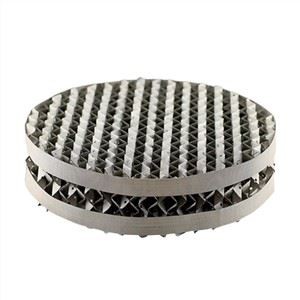

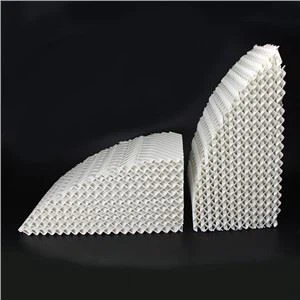

While using structured tower packings, a liquid is forced into specific, preordained arrangements within the column. There are different types of structured tower packings that can be used.
Instead of utilizing many small pieces, structured tower packings consists of large pieces of material. This material contains holes, grooves, corrugation and other textured elements that allow for increased surface area and contact ability. Structured tower packings, especially older structured tower packings, is often made of sheet metal, but it can also be made of plastic, porcelain, wire gauze and other materials.
Plastic is particularly useful in applications involving corrosive liquids.
Structured tower packings is used in processing plants to package and store liquid. It is particularly useful in offshore applications, offshore drilling, because the increased liquid spreading helps counterbalance the effects of the constant motion of the offshore plant.
Structured Tower Packing Applications
It can be used in a variety of applications, including seawater scrubbing, deaerating and more. Below are a couple of specific examples of structured tower packings uses in specific applications.
Natural gas dehydration
Structured tower packing is particularly useful in natural gas dehydration. The glycol in natural gas, for example, must be dehydrated before it can pass through pipelines, or the water vapor present in the natural gas may freeze in cold temperatures. If this happens, then ice may damage or burst the pipeline. So glycol can be used to remove the water vapor from the natural gas to prevent ice damage.
The use of structured tower packing for natural gas dehydration has been proven to provide up to twice the capacity and 50% more efficiency than the use of older tray technology. Structured tower packing can also be used to decrease the diameter of the absorption column. The many textured elements of the structured tower packing increase surface area without necessitating a corresponding increase in diameter to achieve the same efficiency. This makes the absorption vessel, smaller, lighter and cheaper.
Styrene manufacture
Another application of structured tower packings is in the manufacture of styrene, a chemical used to to make latex, plastic packaging, disposable cups and a variety of other products. Styrene is also manufactured using the distillation process, typically with the help of steam as a heating agent. Structured tower packings is useful here because styrene polymerizes rapidly at high temperatures. Structured tower packings offers low bottom temperature and low pressure drop, both conditions that help prevent chemical reactions as the styrene is produced.
When metal structured tower packings materials were first implemented in styrene production, the pressure drop was reduced from 500 millibars under the previous tray system to only 40 millibars — A substantial and groundbreaking improvement in performance. This much lower pressure drop allows for much purer styrene that does not have quantities of ethylbenzene, the chemical precursor of styrene, mixed in.
Coatings on Structured Tower Packings
In commercial gas treating applications, structured tower packings is usually preferred over random packing due to its lower pressure drop (due to higher void fraction) as well as potential for higher surface area per given volume, resulting in a better separation efficiency for the same absorber column height. The most common type of structured tower packings used in pilot and commercial demonstration CO2 capture units is corrugated, perforated thin sheets of stainless steel bundled into cylindrical packing.
Sol–gel-derived coatings often have poor adhesion to stainless steel directly, so a thin silica layer is typically deposited first as a primer layer to improve the long-term adhesion of the top coat. after dip coating in a diluted derived gel and subsequent heat treatment (up to 600 °C), backscattering spectroscopy revealed a transition layer where the silicon oxide layer was directly bound to the iron in the steel.70 In the same vein, reported the deposition of a dense uniform silica-alumina coating on stainless steel via dip coating a gel using and aluminum tri-sec butoxide precursors and a heat ramping cycle to 675 °C.
To create a robust silica primer layer on stainless steel for in-house testing, the stainless steel packing sheets were dip-coated into a derived gel and cured in a furnace on a heat ramping cycle to 650 °C. This silica primer layer survived exposure to several weeks of soaking in carbonate solution, whereas the same coating under more modest heating (<450 °C) was etched away under comparable storage conditions. More importantly, the presence of this silica primer layer significantly improved the adhesion of a porous CA-containing organosilica coating to enable optimization of the deposition process.
Structured tower packings have been established for several decades. The first generation of structured packing arose in the early 1940s. In 1953, a patented packing appeared named Panapak, made of a wavy-form expanded metal sheet. The packing was not successful, due to maldistribution and lack of good marketing. The second generation appeared at the end of the 1950s, with highly efficient wire mesh packings, such as Goodloe, Hyperfil and Koch-Sulzer. Until the 1970s, due to their low pressure drop per theoretical stage, those packings were the most widely used in vacuum distillation. However, high cost, low capacity and high sensitivity to solids have prevented wider utilization of wire mesh packings.
Corrugated structured tower packings, introduced by Sulzer by the end of the 1970s, marked the third generation of structured packed columns. These packings offer high capacity, lower cost, and less sensitivity to solids, while keeping a high performance. Popularity of the packings grew in the 1980s, particularly for revamps in oil and petrochemical plants. These structured tower packings, made of corrugated metal sheets, had their surfaces treated, chemically or mechanically, in order to enhance their wettability. Consequently, the packings' wetted area increased, improving performance. In 1994, a new geometry was developed, and called Optiflow. Later, in 1999, an improved structure of corrugated sheet packings, the MellapackPlus, was developed based on CFD simulations and experiment. This new structure, compared with conventional Mellapak, has a lowered pressure drop and maximum useful capacity could be extended up to 50%.

Types of Structured Tower Packings
The uniformed arrangement of structured packing offers many advantages compared to other types of packing or trays. They are useful in many applications, such as those where precise liquid spreading is needed, such as offshore applications that are subject to permanent tilt and motion. There are several types of structured packing that can be used in process plants.
Gauze – It is the preferred packing for deep vacuum and low liquid rate applications. It has the lowest pressure drop per theoretical stage, making it the ideal choice for processing specialty chemicals, pharmaceuticals, and materials that are sensitive to temperature.
Knitted – Knitted packing can be rolled into one-piece layers to fit small diameter columns. It can also be wrapped back and forth to create rectangular bricks to be used in column manways. The multi-strand wires offer high surface area and high mass transfer efficiency at a higher-pressure drop than woven gauze.
Sheet Metal – This packing can handle a much wider range of vapor and liquid rates, as well as process services. Process applications range from low-pressure drop vacuum and atmospheric distillation services to medium high-pressure absorbers. Sheet metal packing can even handle a modest amount of fouling with adequate liquid loading to keep the packing wetted.
Grid – Grid packing can provide extended operation in fouling services. Corrugated sheet metal and stamped blades are considered grid packing. Both types are highly durable with large open areas to facilitate highly fouling process streams. Corrugated grid packing has a smooth surface to minimize fouling and is constructed of much thicker material than the normal sheet metal packing.
Structured Tower Packings Basic Considerations
Manufacturing process turn raw materials into useful products, however, some of the by-products of manufacturing are harmful to the environment. The presence of hundreds of potentially toxic chemical substances in the environment is known as chemical pollution. These pollutants contaminate the water, soil, air, and food. Manufacturing plants, refineries, and wastewater treatment facilities rely on the dependable design of structured tower packings for chemical separation and mass transfer processes to remove gas and liquid pollution contaminants before they reach the atmosphere. Structured tower packings also known as mist eliminators are commonly found in absorption, distillation, stripping, heat exchangers, cooling towers, and other operations, such as the removal of dust, mist, and odors.
The packed tower scrubber will consist of internals, such as structured tower packings, which is not easy to access after startup, and therefore may be arguably the most important piece of process equipment. If the internals malfunction, the entire process will suffer consequences that can be costly as well as lead to fines and shutdown.
Packed columns are used in a range of industries to allow intimate contact between two phases, which can be liquid/gas or liquid/liquid. The main objective is to promote a uniform distribution of gas and liquid. Doing so is imperative to generate good contact between the liquid and the vapor phase to promote effective mass transfer.
Benefits of Structured Tower Packings
It is crucial in structured tower packing to make room for vapour as well as the liquid to come into touch with one another. Packing that allows the liquid to spread out into a thin film is an effective method for this. Because of the increased contact, performance is improved with this arrangement. Some structured packaging materials are designed with extra textures to facilitate the spreading of liquids. In low-pressure situations, where internal pressure is insufficient to distribute the liquid, the need for liquid spreading becomes all the more pressing.
When the pressure is very low or the flow rate is very high, structured packing is preferable because it has a lower pressure drop and can withstand a significant volume of flow than random packing. There are further advantages as a result of this reduced pressure drop. It permits greater volatility, which aids in more challenging separation operations. In addition to improving energy efficiency, it also decreases foaming.
Our Factory
Super Packing Mall is a leading manufacturer specializing in tower packing. Our tower packing is well accepted by overseas customers. It includes metal, ceramic, plastic random packing, structured packing, ceramic ball, water treatment material, adsorbent etc.
Our Product are used for industries like chemical industry, chemical fertilizer industry, oil refining, petrochemical industry and natural gas, fine chemical, flavors factory, air pollution control, isomer separation, the separation of thermally sensitive materials etc.